
Website vs. Web App: What Does Your Business Actually Need?Web Development
Volver al blog
Web Development
WordPress vs Custom Development: Which Does Your Business Need?
WordPress or custom code? This is one of the most important decisions when creating or redesigning a website. Here's how to choose wisely based on your real case.
M
Written by Miguel Prot
Published by Hamaca Web Solutions
8 min read
One of the most frequent questions when someone is planning their website is: WordPress or custom development?
The answer isn't as simple as "one is better than the other." Like almost everything in technology, it depends on your specific case.
In this article we give you an honest analysis of both options — without bias — so you can make the right decision for your project.
What Is WordPress and What Is Custom Development?
WordPress is a content management system (CMS) that currently powers approximately 43% of all websites in the world. It's a mature platform with a huge ecosystem of themes and plugins that any designer or developer knows.
Custom development means building the site from scratch, using proprietary code (React, Next.js, Laravel, etc.) without relying on a predetermined platform. Every element is designed and developed specifically for your project.
Both options are completely valid — but for different projects.
When WordPress Is the Best Option
WordPress remains an excellent solution in many contexts. It makes sense when:
✅ You need to go live quickly
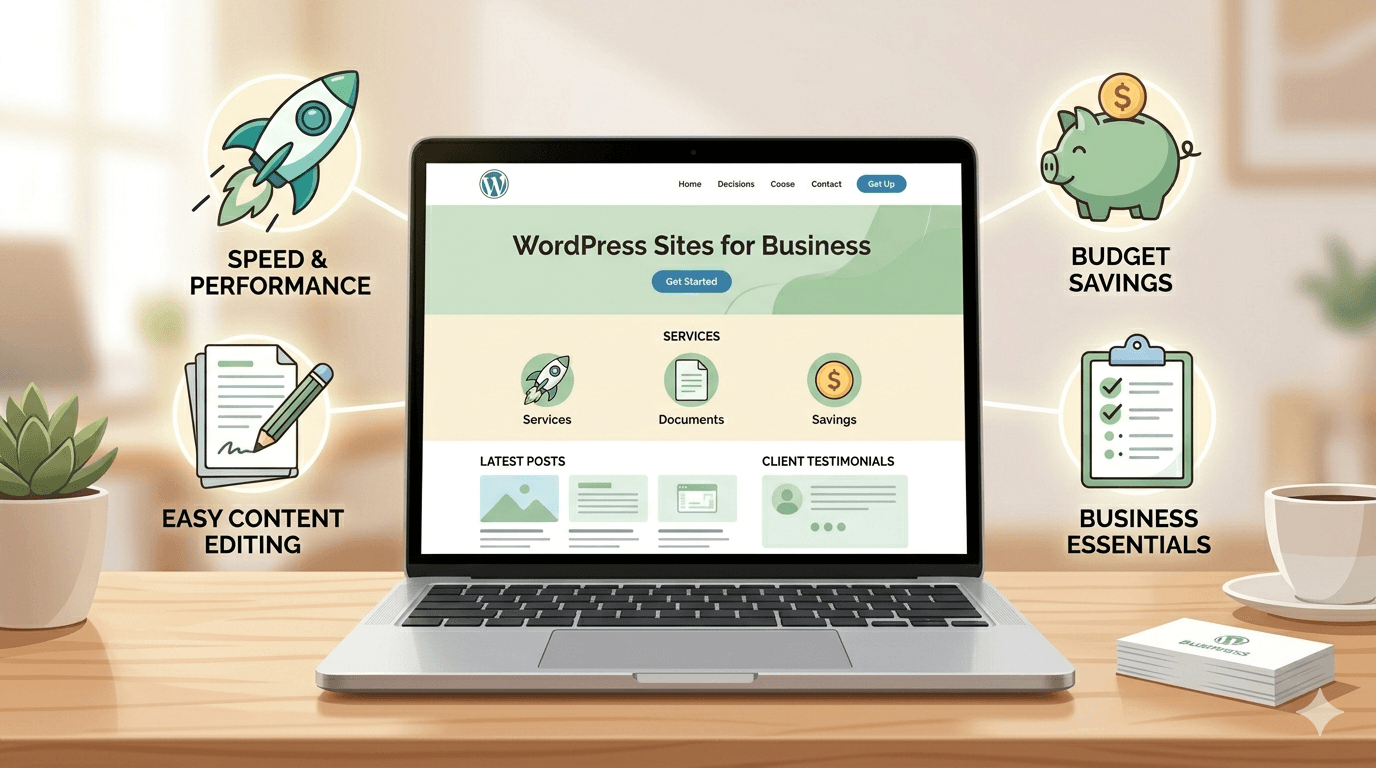
WordPress allows you to launch sites in less time than custom development. If your goal is to have functional digital presence in weeks, WordPress is unbeatable in deployment speed.
✅ You want to manage your content without depending on a developer
With plugins like Elementor, ACF, or Gutenberg properly configured, you can update text, images, and pages without touching code. Ideal for businesses that publish content frequently.
✅ Your budget is limited
Because it reuses existing infrastructure, WordPress generally has a lower development cost. That doesn't mean lower quality — it means there's efficiency in the process.
✅ Your needs are standard
Corporate blog, informational site, landing pages, portfolio, store with WooCommerce. For these types of projects, WordPress is more than proven.
The Limitations of WordPress
Being honest about WordPress also means recognizing its limits:
- Performance: WordPress sites can be slow if not well optimized. They require active maintenance of plugins, cache, and updates.
- Security: Due to its popularity, WordPress is the most attacked CMS. It's not inherently insecure, but it requires constant management.
- Technical flexibility: For projects with very specific or complex features, WordPress can become a limitation. Sometimes the "almost perfect" plugin is never exactly what you need.
- Technical debt: A WordPress site with 20 plugins accumulated over the years can become a fragile, hard-to-maintain system.
When Custom Development Is the Best Option
Custom development has advantages that no CMS can replicate. It makes sense when:
✅ You have very specific functional requirements
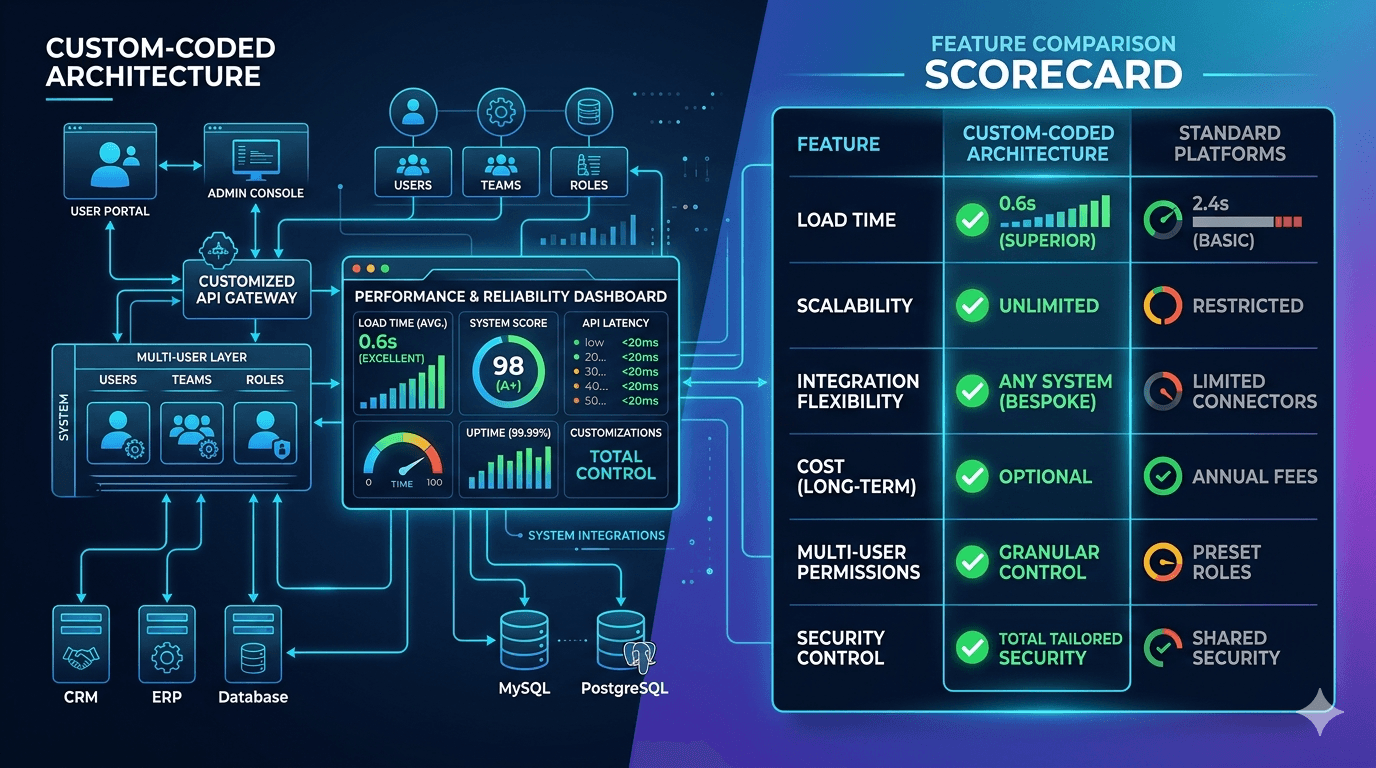
If you need complex user flows, deep integrations with external systems (ERP, CRM, custom APIs), personalized business logic, or multi-user architecture — custom code is the only real option.
✅ Performance is critical
Without the overhead of WordPress and its plugins, a custom site can be significantly faster. For projects where Core Web Vitals and technical SEO are priorities, this matters a lot.
✅ You're scaling long-term
If your platform is going to grow, add features, have multiple versions, or serve thousands of simultaneous users, custom architecture gives you the flexibility WordPress can't guarantee.
✅ Security is an absolute priority
A proprietary system, with authentication and architecture specifically designed for your case, is inherently more secure than a public platform with known vulnerabilities.
The Direct Comparison
| Criterion | WordPress | Custom Development |
|---|---|---|
| Launch speed | ⚡ Fast | 🐢 More time |
| Initial cost | 💚 Lower | 🔴 Higher |
| Technical flexibility | 🟡 Medium | 💚 Total |
| Performance | 🟡 Depends on setup | 💚 Maximally optimizable |
| Maintenance | 🔴 Frequent plugins/updates | 🟡 Fewer dependencies |
| Scalability | 🟡 Limited | 💚 High |
| Content editing | 💚 Easy | 🟡 Depends on design |
The Hybrid Option (That Many Don't Know About)
There's a third path that combines the best of both worlds: headless CMS + custom frontend.
In this model, content is managed from a CMS (WordPress, Contentful, Sanity) but the frontend is built with modern technology (Next.js, Astro, Nuxt). The result: the editing ease of a CMS with the performance and flexibility of custom development.
It's the architecture that the most demanding projects are adopting in 2026 — and one we work with frequently.
How to Choose Wisely
The right questions to make this decision are:
- What is the main goal of your site?
- How often do you need to update content?
- What features does the site need in the next 2 years?
- What is your real budget (including maintenance)?
- How important is performance to your business model?
There's no universal answer. There's a right answer for each project.
At Hamaca Web Solutions we work with both technologies — and our first conversation with you always starts with understanding your business, not selling you a predetermined solution.
Two real examples of this decision, applied to full projects: Farmland Fencing needed to self-manage content without depending on a developer, so a custom WordPress build was the right call. Ixtul QH, on the other hand, had a relational challenge —cross-referenced genealogies between horses and foals— that called for Laravel, not a template.
If you want to see this same logic applied to a full project, the Web Development page walks through exactly how I decide on technology and what each project includes.
See the Web Development process Tell me which technology is best for my projectHave a project in mind?
Tell me what you need and we'll figure out the best approach for your business.
Tell me about your project Free quote · Reply within 24 hoursRecommended
- What I Review First When a Business Asks Me to Improve Its WebsiteDevelopment Experience